Every January, the fire service focuses its attention to Cancer Awareness Month — a time to remember those we’ve lost, support those still fighting, and push for stronger protections for active firefighters.
But there’s a group of firefighters who rarely appear in these conversations, despite facing some of the most hazardous environments in the fire service:
Industrial firefighters.
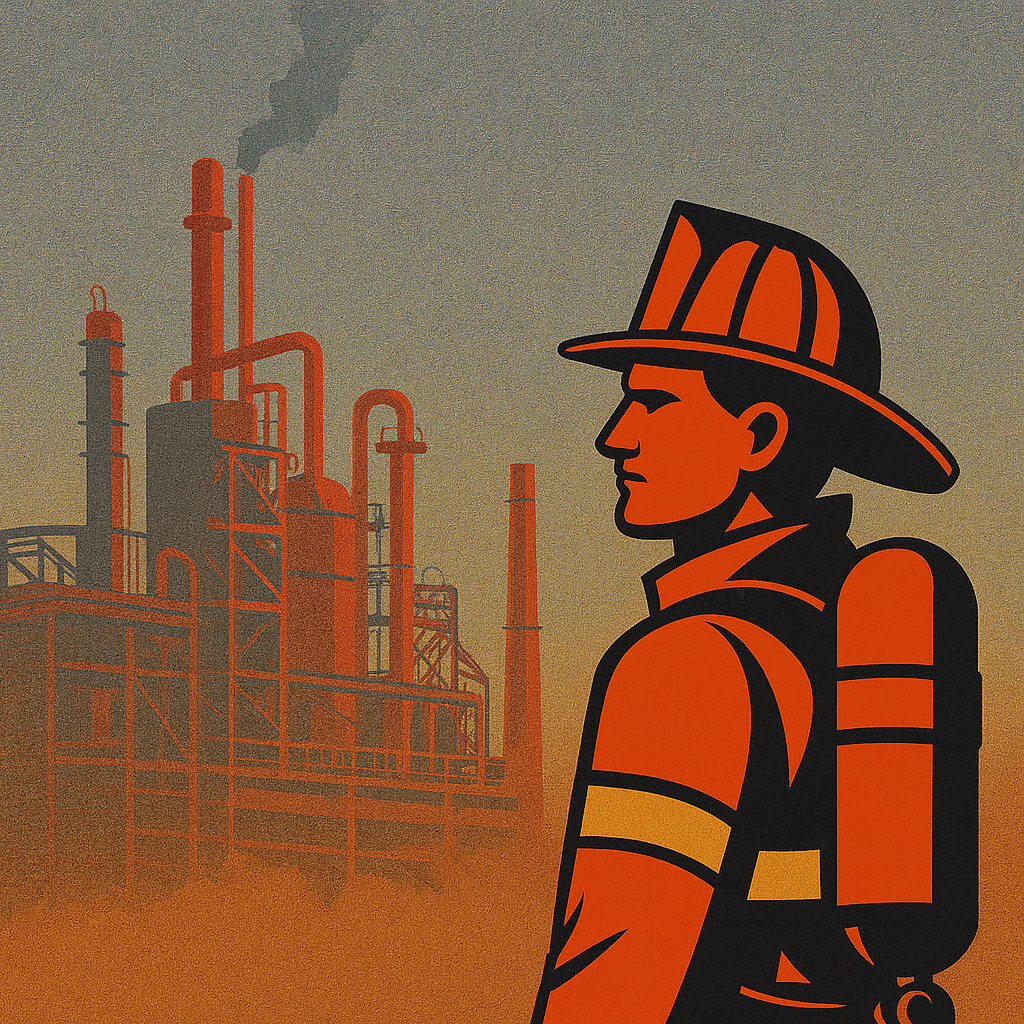
Industrial firefighters are the responders protecting refineries, chemical plants, steel mills, manufacturing facilities, ports, and other high‑risk industrial sites. They operate in environments where hazards are concentrated and complex — from toxic exposures and biological hazards to vessel overpressures, jet fires, and hazardous waste.
Despite these risks industrial firefighters are excluded from most of the same protections offered to other firefighters and their families.
The Legal Gap No One Talks About
- State presumptive cancer laws do not include industrial firefighters.
Presumptive laws flip the burden of proof:
In a traditional case, the firefighter needs to prove that their cancer was caused by a work-related exposure. Under presumptive health laws the burden become the employer’s to demonstrate the cancer (or other covered diagnosis) was NOT caused by the a line-of-duty exposure.
In nearly all states, industrial firefighters — even those performing structural firefighting, hazmat, rescue, and EMS — are not included in these laws. That means they must rely on employer‑provided insurance or the benefits of their contracted employer which may not cover occupational cancer or long‑term illnesses.
- Industrial firefighters are excluded from the federal PSOB program.
If an industrial firefighter dies in the line of duty, their family is not eligible for federal Public Safety Officers’ Benefits — even if they were performing the same tasks as municipal firefighters, using the same equipment, and facing the same hazards. These benefits can be critical for survivors when faced with medical bills and replacing income. A painful reality for industrial firefighters and their families is that the PSOB death benefit is almost $450,000 and a spouse and children are eligible to receive education assistance.
The Contract Staffing Reality
Many industrial fire departments proudly display the company’s name on the door of the fire engine, the ambulance, and even their uniforms. Behind that branding the firefighters staffing the rig and responding to calls may be employees of a contract company — often with:
- Lower pay
- Fewer benefits
- Limited or no long‑term disability coverage
- No presumptive cancer protections
- No line‑of‑duty death benefits
Industrial Firefighters Protect More Than Their Facilities
One chief recently shared with me that his industrial department responds up to a mile off‑site to support the local community. This is not unusual. Two facility fire departments I worked for early in my career were part of the county mutual aid plan.
Industrial firefighters routinely:
- Provide mutual aid to municipal departments
- Respond to community emergencies
- Protect surrounding neighborhoods from industrial incidents
- Mitigate hazards that could impact thousands of people
When an industrial site has a fire, explosion, or toxic release, the public is at risk. These firefighters are not just protecting their facility — they’re protecting the community. They have the intimate knowledge of the facility’s hazards and processes and can be on-scene, managing the problem, within minutes.
Yet the laws meant to protect firefighters do not protect industrial firefighters.
Why This Matters for Cancer Awareness Month
Cancer does not care:
- Whether your paycheck comes from a city or a corporation
- Whether your turnout gear says “Fire Department” or “Emergency Response Team”
- Whether you’re municipal, industrial, volunteer, or contracted
No matter if you’re fighting fires, managing hazmat, or responding to unique industrial emergencies, you’re exposed and at a higher risk for cancer than the general population.
And exposure is exposure. The protection should match the risk.
🔥 What You Can Do
For Industrial Firefighters
- Review your insurance coverage. Understand what is and isn’t covered for occupational illness, disability, and line‑of‑duty death.
- Ask your employer or contract company:
- Do we have cancer coverage?
- Do we have line‑of‑duty death benefits?
- What protections exist for high‑risk roles?
- Document exposures. Even if your state doesn’t recognize presumptive cancer laws for industrial responders, documentation matters.
- In the digital age visibility can motivate others to action and create change. Share your story.
For Municipal Firefighters
- Acknowledge your industrial partners. Many respond with you, train with you, and protect your community.
- Support inclusive legislation that benefits everyone.
- Ensure industrial fire departments are represented. Invite these departments into local and regional conversations. They’re part of the fire service family.
For Employers and Contract Companies
- Review your benefits packages. Firefighters managing your emergencies deserve high‑quality protections.
- Consider parity with municipal benefits. Especially for cancer, disability, and line‑of‑duty death.
- Recognize the public‑facing role of your emergency teams. Even if they never leave the property their impact is protecting more than your facility.
For Policymakers
- Reevaluate the language in presumptive laws. Does it represent the full fire service landscape?
- Include industrial firefighters in cancer protections. Exposure is exposure.
- Expand PSOB eligibility. Families should not be left behind because of an employment classification.
- Include industrial fire leaders in the conversation. They can provide data and real‑world context.
For the Public
- Understand who protects you. Industrial firefighters are part of your community’s safety net.
- Share this message. Awareness is the first step toward change.
- Ask your representatives: Are all firefighters protected?