
NFPA 350 Answers What OSHA Doesn’t
If you manage confined space entries at an industrial facility, you’ve read OSHA 1910.146. You know it requires a designated rescue service. You know that service has to be proficient, equipped, and capable of responding in a timely manner.
But here’s the problem: OSHA never defines timely.
The exact language in 29 CFR 1910.146(k)(1)(iii)(A) requires a rescue team that “has the capability to reach the victim(s) within a time frame that is appropriate for the permit space hazard(s) identified.” That’s it. No minutes. No tiers. No definition of appropriate.
It’s a regulation intended to prevent confined space fatalities, but that’s a significant gap — and it’s one that has led many facilities to assume their municipal fire department is an adequate rescue service for any confined space, regardless of the hazards present.
It usually isn’t.
What NFPA 350 Actually Says
NFPA 350, Guide for Safe Confined Space Entry and Work (2022), exists largely to fill the gaps created by OSHA’s performance-based language. It doesn’t conflict with 1910.146 — it operationalizes it.
One of the most useful things NFPA 350 does is define three rescue response modes, called tiers, and assign specific time requirements to each. The tier that applies to your space is driven by the hazards present.
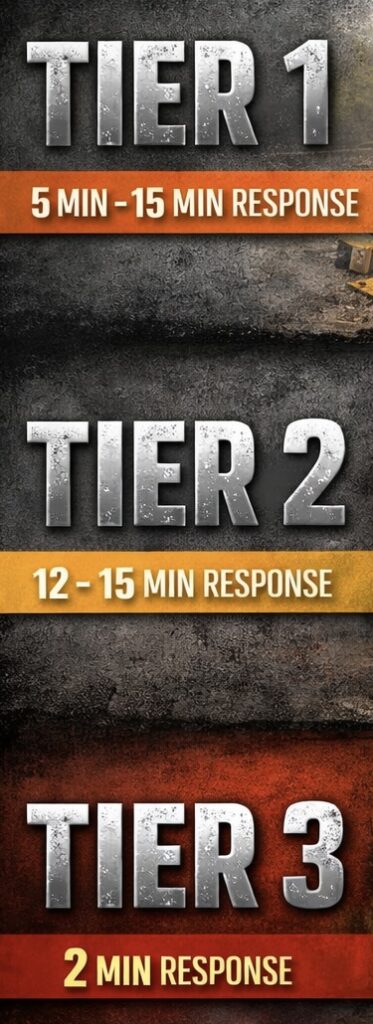
Tier 1
Applies when no recognized hazards exist, but the space configuration — a vertical shaft greater than 4 feet, a restricted portal, internal obstructions — could prevent self-rescue if a worker becomes incapacitated.
Requirement: A fully trained rescue team that can arrive within 5 minutes and be ready for entry within 15 minutes of arrival.
Tier 2
Applies when non-life-threatening hazards are present — hazards that could incapacitate a worker or prevent self-rescue but don’t represent an immediate threat to life. Hot work, chemical introduction, entrapment configurations, non-IDLH atmospheric hazards.
Requirement: A fully trained rescue team on site, mobile and equipped, capable of setup and entry within 12–15 minutes of incident notification.
Tier 3
Applies whenever an IDLH atmosphere exists or could develop — confirmed or potential. Engulfment hazards. Uncontrolled energy sources. Any condition representing an immediate threat to life.
Requirement: A dedicated rescue team standing by in the immediate work area, fully staged, capable of entry within 2 minutes of incident occurrence. No other responsibilities during the entry.
Why This Matters for Your Local Fire Department
When most facilities designate their municipal fire department as the rescue service, they’re picturing a Tier 1 scenario: a medical event in a vault, the space is clear, the FD responds, sets up, and makes entry.
That picture collapses the moment you introduce a Tier 2 or Tier 3 space.
NFPA 1670 Annex A — the standard governing fire department technical rescue teams — establishes a goal of responding to confined space emergencies within 15 minutes of notification. That’s dispatch-to-arrival, before setup even begins.
For a Tier 3 entry where a worker is exposed to an IDLH atmosphere, the 2‑minute window closes long before the first engine reaches your gate.
This isn’t a criticism of municipal fire departments. It’s simply a function of how they’re staffed and deployed. The point is that a single designated rescue service — no matter how competent — cannot be the appropriate rescue capability for every confined space in every tier. The hazard profile has to drive the decision.
Using the Tier Framework in Practice
Most facilities with large confined space inventories have spaces across all three tiers. A utility vault with no atmospheric hazards and a clear opening is a Tier 1 space. A reactor vessel with residual scale and potential hydrogen sulfide release is a Tier 3 space.
Treating them the same way — either over-resourced or under-resourced — is inefficient at best and unsafe at worst.
NFPA 350 Table A.10.9.1 goes further by mapping specific rescue team staffing requirements to the conditions present: entanglement hazards, retrieval systems, vertical extraction, atmospheric hazards requiring SCBA or SAR.
The minimum crew ranges from one non-entry rescuer on a low-complexity Tier 2 entry to eight rescuers on a high-complexity Tier 3 entry with SAR and vertical extraction.
That’s not regulatory box-checking. That’s the actual number of trained people you need staged and ready before your worker goes through the portal.
A Tool to Help You Apply This
I built a step-by-step assessment tool that walks through the NFPA 350 hazard classification framework — inherent hazards, introduced hazards, adjacent hazards, and atmospheric conditions — and produces:
- Tier determination
- Minimum team staffing
- Positioning requirements
…based on your inputs.
It’s grounded in NFPA 350 (2022) and OSHA 1910.146. It takes about three minutes. It’s free. No account required.
If you’re using it to evaluate spaces at your facility, start with your highest-hazard spaces — the ones where you’ve historically assumed your existing rescue coverage was adequate. You may find the tier designation confirms what you already knew. You may find it surfaces a gap worth addressing before someone goes in.
Either outcome is useful.
Alex Zielinski is a Deputy Chief and Division Chief of Training at an industrial fire department and the founder of TrainTeachLead.com. He presents on industrial firefighter performance, confined space rescue, and fire service leadership at national conferences including FDIC International and the NFPA Conference and Expo.