
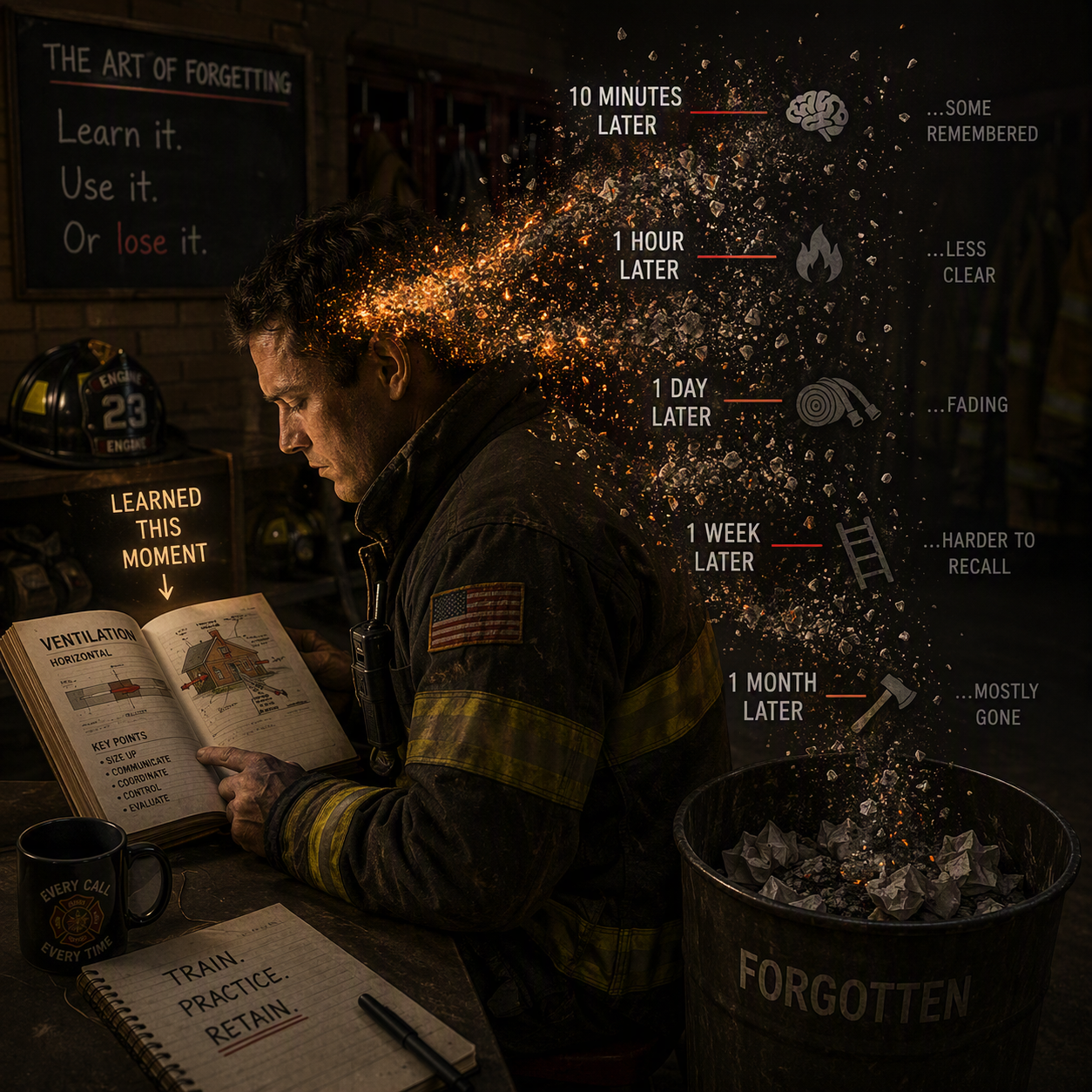
You ran a great class. The crew was engaged. The feedback was positive. But when you’re three weeks later half of them can’t recall the main points.
This isn’t because they’re terrible students, unmotivated or undisciplined, at least not entirely. Science says this is a memory problem and it’s not just a recent one.
The Forgetting Curve
In 1885, German psychologist Hermann Ebbinghaus documented something that should make every fire instructor should consider: after learning new material, 42% of the information is forgotten within 20 minutes. 67% was lost after one day and 79% after 31 days!
Ebbinghaus termed this “savings.” Savings was his method for measuring how much faster he could relearn a list of syllables on a later attempt compared to the first time. He translated that information into diagrams he called diagrams of retention and time. When his work was later translated it became “the forgetting curve” or “the learning curve” and it applies to everything we teach.
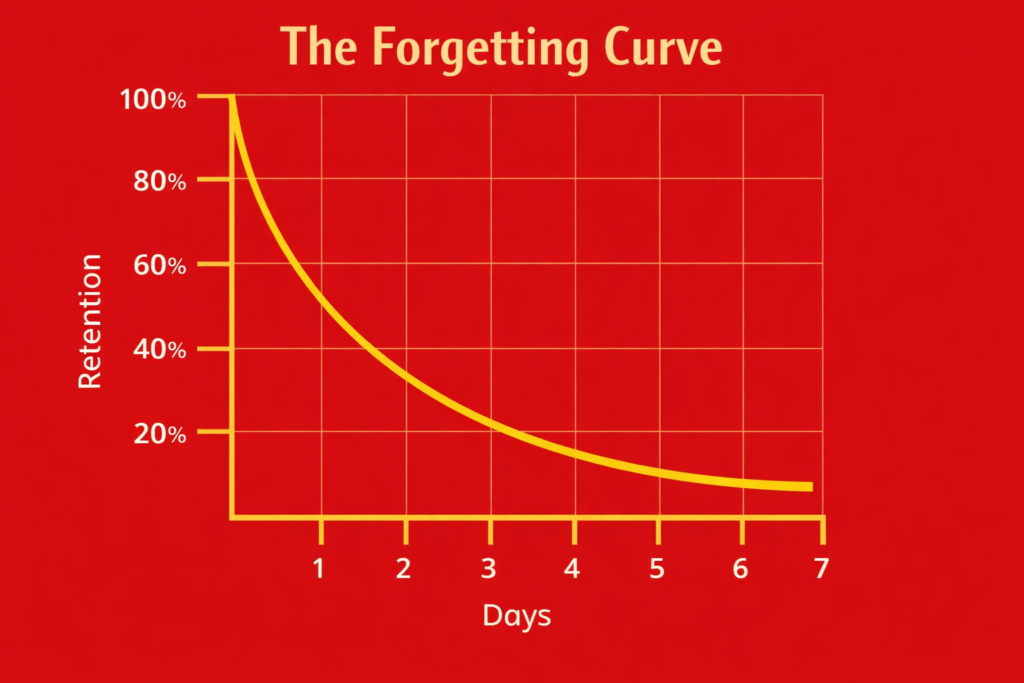
The shape of the curve is what matters, it’s not gradual. The biggest drop in retention happens almost immediately after learning new information, not weeks later. By the time firefighters show up for the next training they’ve already started forgetting what you covered last time.
This isn’t a flaw in your firefighters. It’s how human memory works.
What fire service training gets wrong
If we’re talking about low frequency events, and especially in departments where we’re focusing on compliance instead of performance (performing a simulated confined space rescue once a year instead of enough to ensure high-quality performance), we deliver training once. We check a box, and move on. And this is true in many geographies for certification classes, one-day training classes, and four-hour refreshers. If we revisit the material at all, it’s 30 days, three months, or twelve months later. By that point we’re essentially starting over.
Without regular reinforcement and opportunities to apply the knowledge and skills, even the best-designed training will quickly be forgotten. The curve doesn’t care how good your class was.
The good news: the curve isn’t inevitable
Ebbinghaus, and other researchers since then, noticed that with each repeated exposure to the same material, the speed of forgetting slowed significantly. Each review resets the curve and makes the next decline more gradual. Over time, the intervals between reviews can grow longer while retention remains strong.
Three strategies translate directly to the fire service training environment
Spaced Repetition
Instead of covering a topic once in depth, return to it repeatedly at increasing intervals. Review it at the end of the shift. Revisit it briefly two days later and then again at next week’s training. Distributed practice produces better retention than massed practice and the 10-30% improvement that some researchers noted is a significant difference. It’s the difference between a crew that performs under pressure and one that freezes.
Retrieval Practice
Don’t re-read your notes to your crew. Make them pull the information out themselves. Ask questions. Run brief scenarios that require application of something covered two weeks ago. Retrieval practice combined with spacing produces large gains in long-term retention and it only takes five minutes at the start of a shift training, not a dedicated class.
Overlearning
Don’t stop training a skill the moment a firefighter or the entire crew can perform it correctly once. Continue studying or practicing after mastery helps permanently lock in the information. One successful rep under controlled conditions isn’t enough to immediately translate to high-performance on the foreground. You’re training for performance under stress, fatigue, and noise.
What this looks like in practice
At the start of your next training or drill night, before you cover anything new, ask your crew, “What do you remember from last week?”
Don’t grade the answer. Don’t correct immediately. Just make them retrieve it. That five-minute exercise does more for long-term retention than adding another hour of new content or frustratingly add time to the schedule because you think they completely forgot it all.
We spend a tremendous amount of time and resources in training. We owe it to our crews and to the people we protect to make sure that training actually sticks.
Additional Reading
The forgetting curve
Murre, J.M.J. & Dros, J. (2015). “Replication and Analysis of Ebbinghaus’ Forgetting Curve.” PLOS ONE. https://pmc.ncbi.nlm.nih.gov/articles/PMC4492928/
Retrieval practice / testing effect
Roediger, H. L., & Karpicke, J. D. (2006). Test-Enhanced Learning: Taking Memory Tests Improves Long-Term Retention. Psychological Science, 17(3), 249–255. https://www.jstor.org/stable/40064526.
Spaced repetition
Wiseheart, Melody & Pashler, Harold & Rohrer, Doug. (2006). Distributed Practice in Verbal Recall Tasks: A Review and Quantitative Synthesis. Psychological Bulletin. 132. 354-380. https://doi.org/10.1037/0033-2909.132.3.354.